It was never honesty. It was machinery.

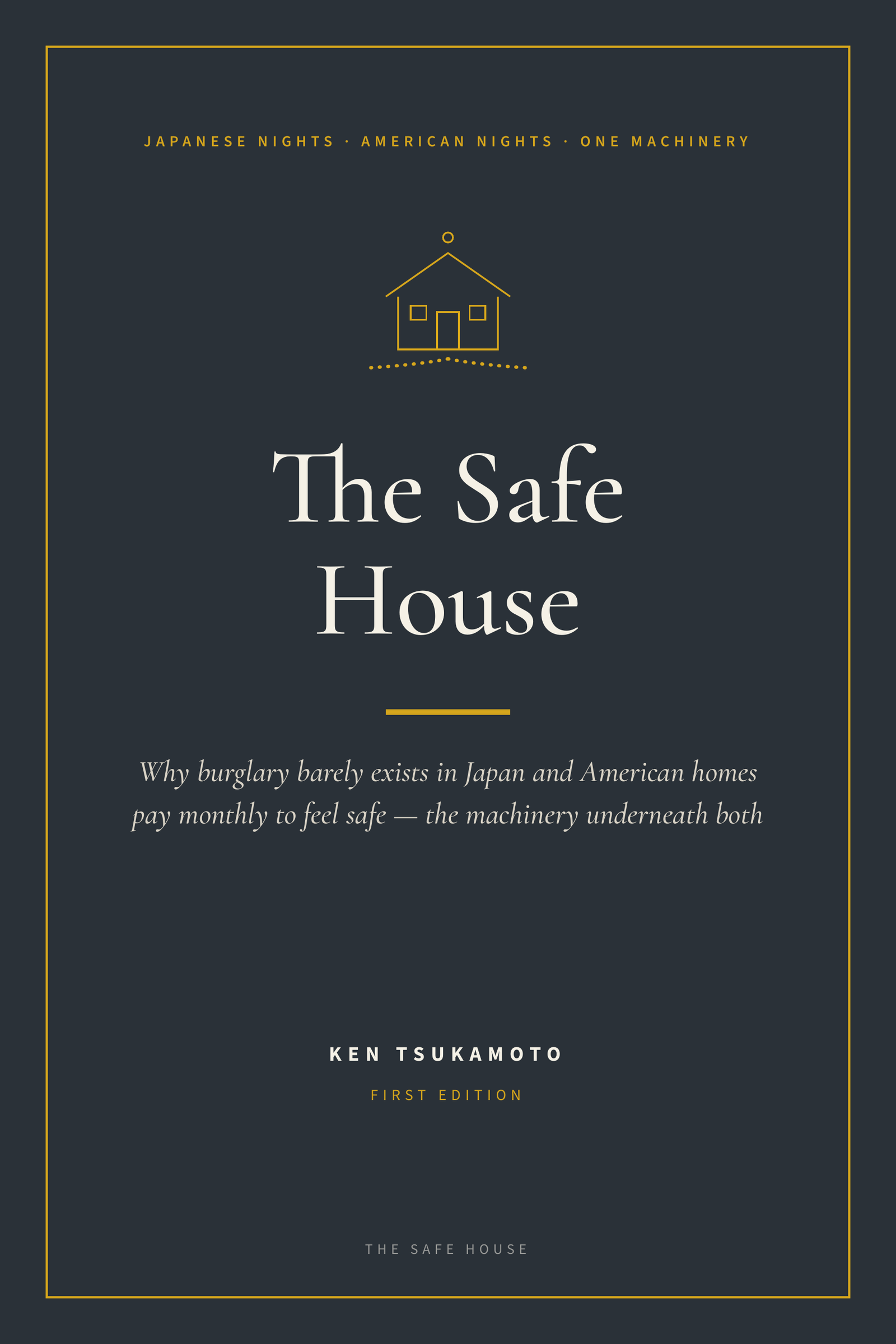
The Safe House is a 482-page digital book by Ken Tsukamoto — why burglary barely exists in Japan, the five minutes that decide every audition, the gravel, the threshold, the intercom, the street that answers, and the ninety-second look your own house has never been given.

$47$79

Early-bird price until the launch window closes.

Get the Book — $47

Digital book (PDF) · Read on any phone, tablet or computer, or print it · 30-day money-back guarantee · Secure checkout

Ken Tsukamoto at his desk
The Safe House — book cover

482 pages · 86 chapters · five appendices · a graded source ledger at the back

Maybe it's the monthly fee — the camera subscription whose entire contribution to date is a library of footage of nothing. The alarm sign in the yard for a company you were never a customer of. The sliding door secured by optimism. Or the quieter thing: a house you lock every night without ever once having looked at it the way the person who chooses houses does — from across the street, in ninety seconds.

I grew up in a country where residential burglary is a rounding error. My mother, in her seventies, lives alone at the edge of a field and has never been broken into — nor has anyone on her street, in living memory. Everyone says Japanese honesty. It isn't. It is machinery: gravel engineered to be loud, a threshold built below floor level, a video intercom that was standard equipment in the 1980s, supplementary locks the police themselves tell you to add, a police box three minutes from every door, and a neighbor whose good-morning ended more burglaries — in the survey of the burglars themselves — than any lock. The whole apparatus was built around one researched fact: most intruders abandon any entry that resists for about five minutes, and nearly all of them choose the house before they ever touch it. The machinery makes sure the house is never chosen. It costs pocket money. It has no subscription. And almost every piece of it works on an American house.

Two honest warnings before you buy. Nothing in this book is a guarantee — its currencies are odds, minutes, and witnesses, never certainty. And it ends at the property line: no weapons, no confrontation, nothing about what happens past the door except the one sentence that belongs there — leave if you can, and call the emergency number where you live. There is also a whole part on what American security genuinely does better, and I mean every row of that table.

What's inside

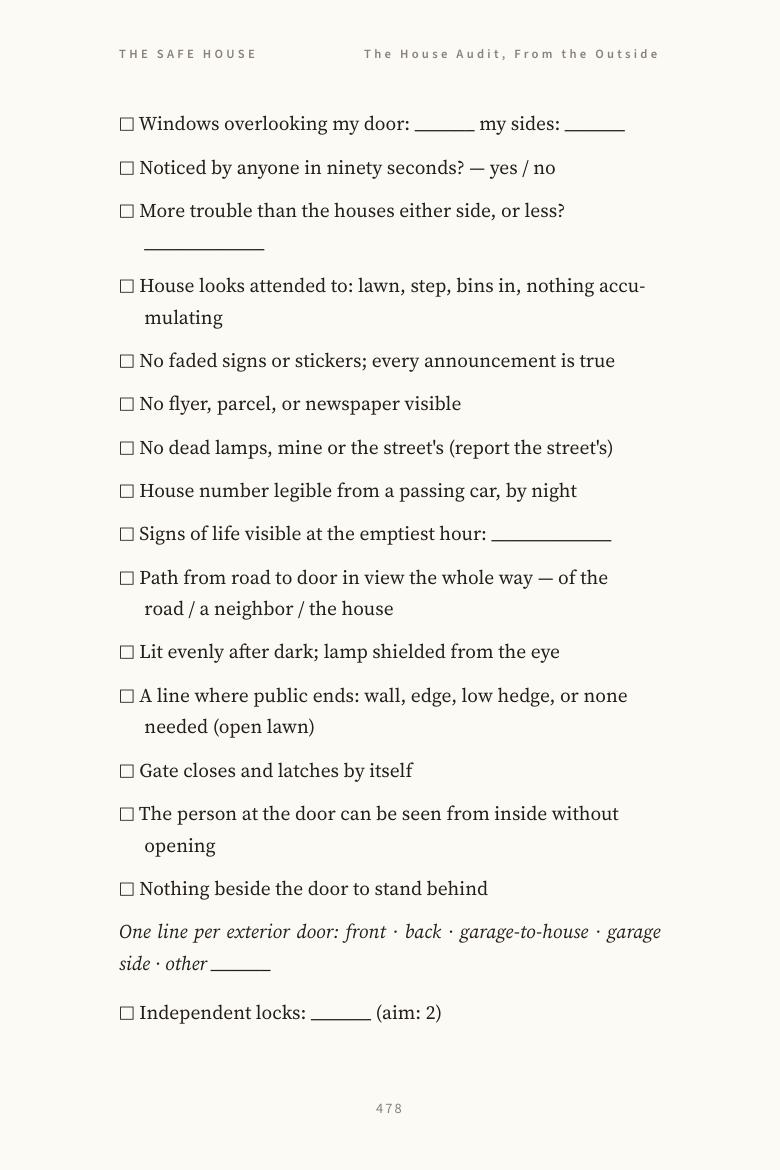
482 pages · 86 chapters · five appendices — including the graded source ledger, a glossary, the Myth Register (where the honesty story is formally retired), and both printables: Seven Evenings, Seven Layers and the House Audit, From the Outside.

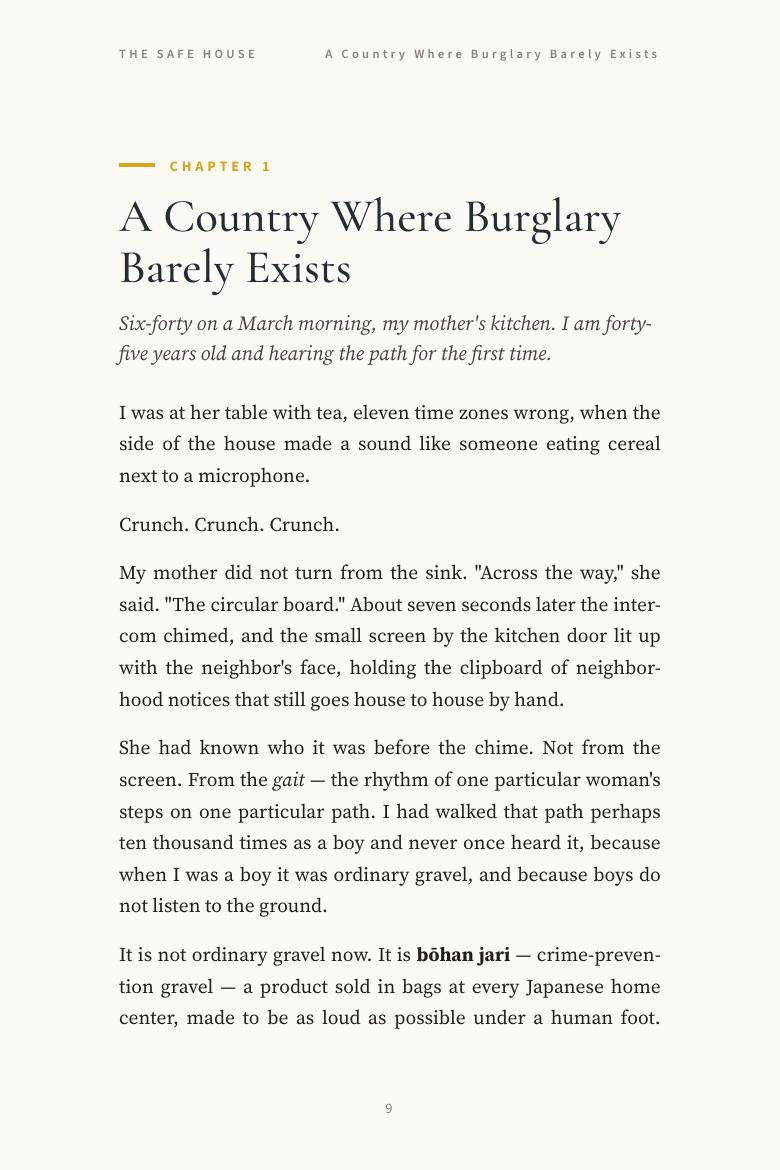
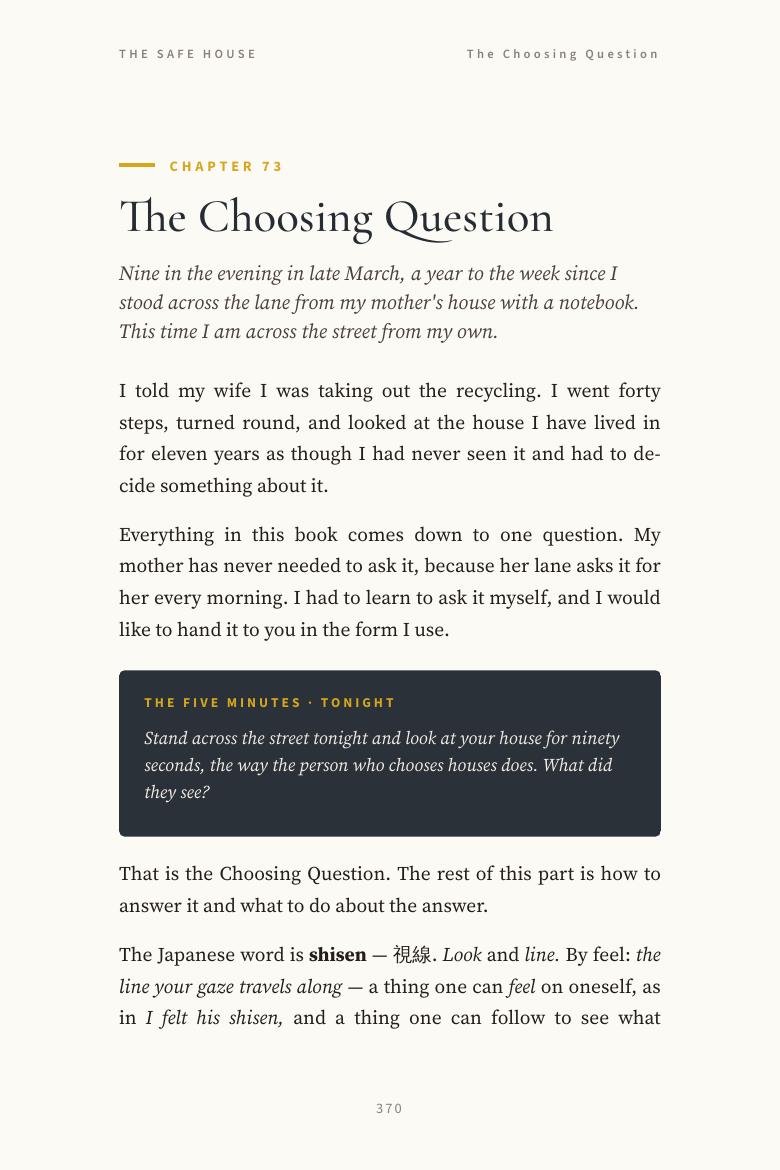
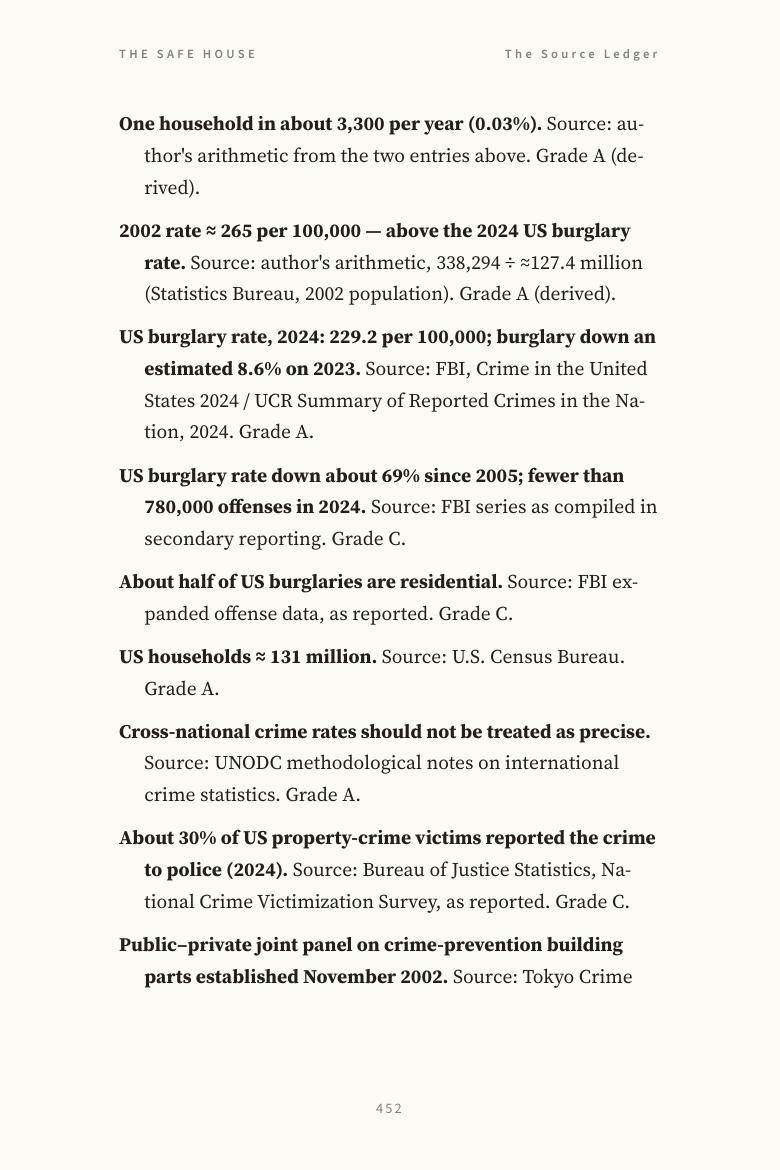
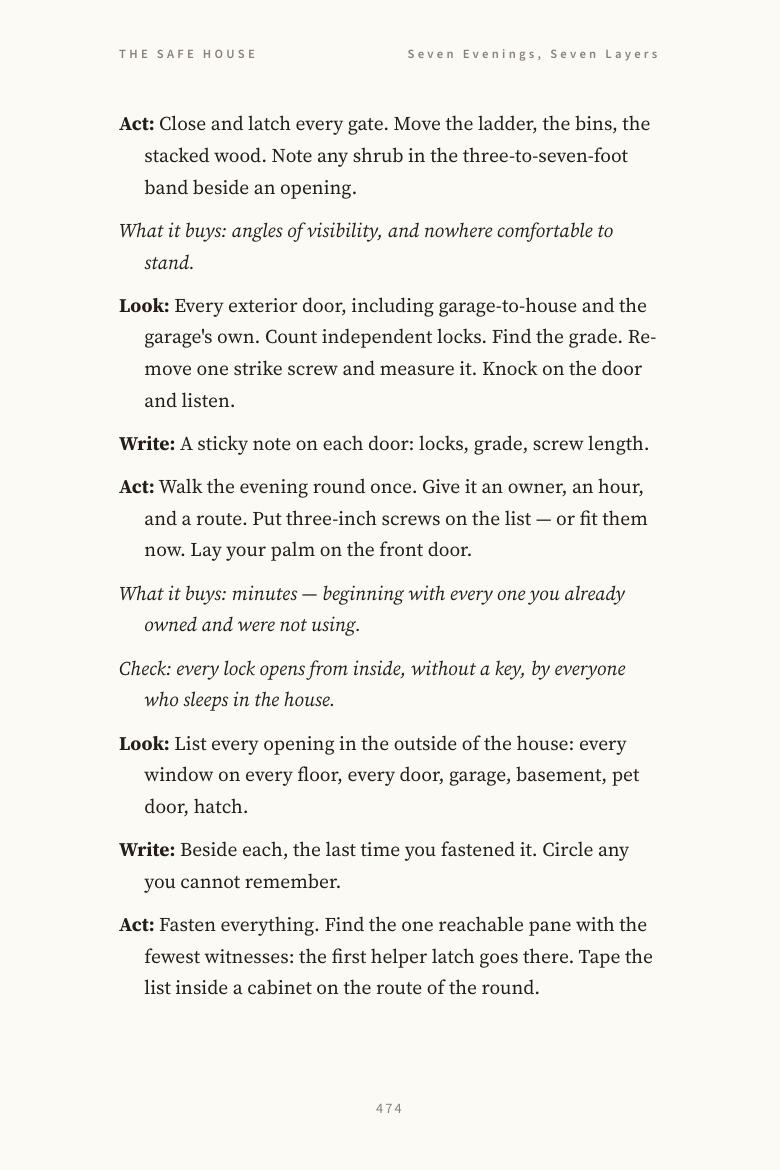
Every chapter has the same parts: the machinery, named and sourced; the memory from the house at the edge of the field; the honest concession to America; and THE FIVE MINUTES — one thing to check or change tonight, and what it buys in minutes, angles, and witnesses. Here are eight real pages.

Tap any page to enlarge it.

What the book covers

It starts with a statistic and ends with your own house, seen from across the street. Fourteen parts, in order.

I · The Rounding ErrorA country where burglary is a rounding error — the numbers, sourced; the honesty story denied; her street, in living memory.
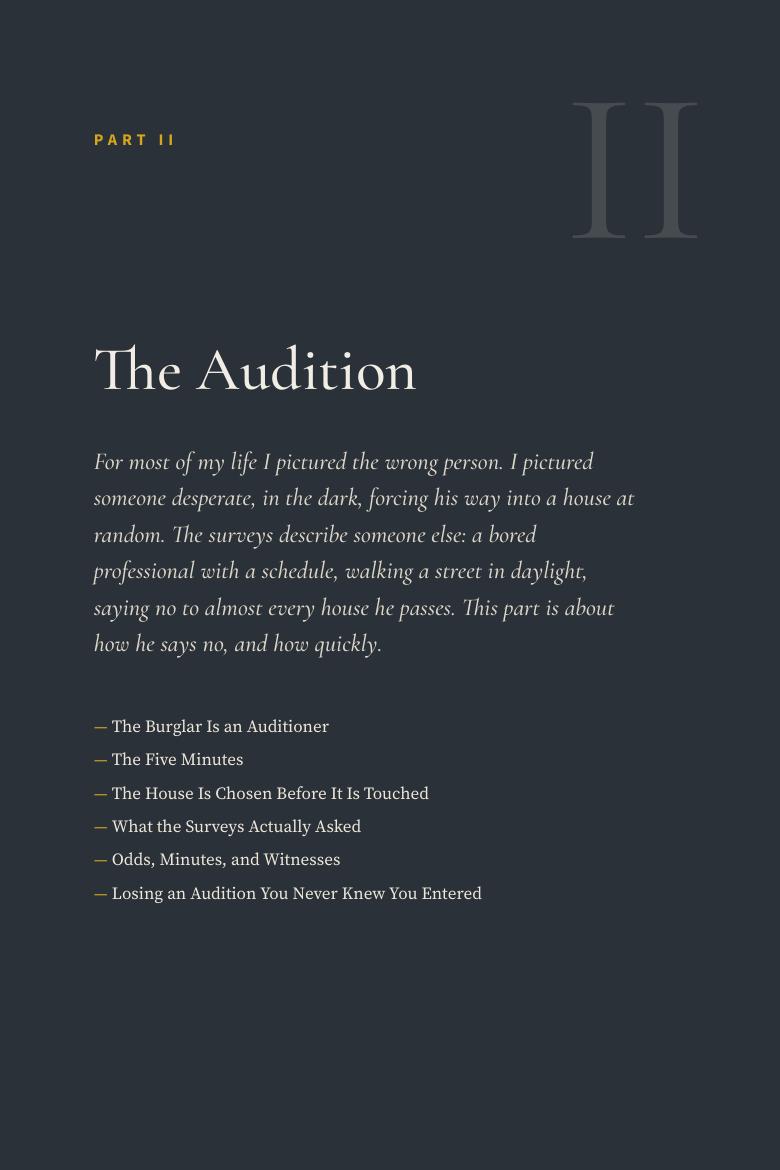
II · The AuditionThe burglar is an auditioner: the five minutes, the surveys of the people who did it, and losing an audition you never knew you entered.
III · The GroundThe ground — gravel that shouts, the approach as corridor, sightlines as a material, the low wall on purpose.
IV · The ThresholdThe threshold — the step down at the door, One Door Two Locks, the CP mark: a standard, not a brand.
V · The WindowsThe windows, where the audition is usually won — the second lock on the sash, film and bars with their honest limits, the amado.
VI · The Light and the DarkThe light and the dark — the lived-in look as a craft, the timer older than the app, the sensor light's one job.
VII · The IntercomThe intercom — standard equipment since the eighties; the door answered without opening; what the camera doorbell got right, and what it subscribed.
VIII · The Street that AnswersThe street that answers — the police box, the officer who visits, the good-morning as surveillance, eyes without cameras.
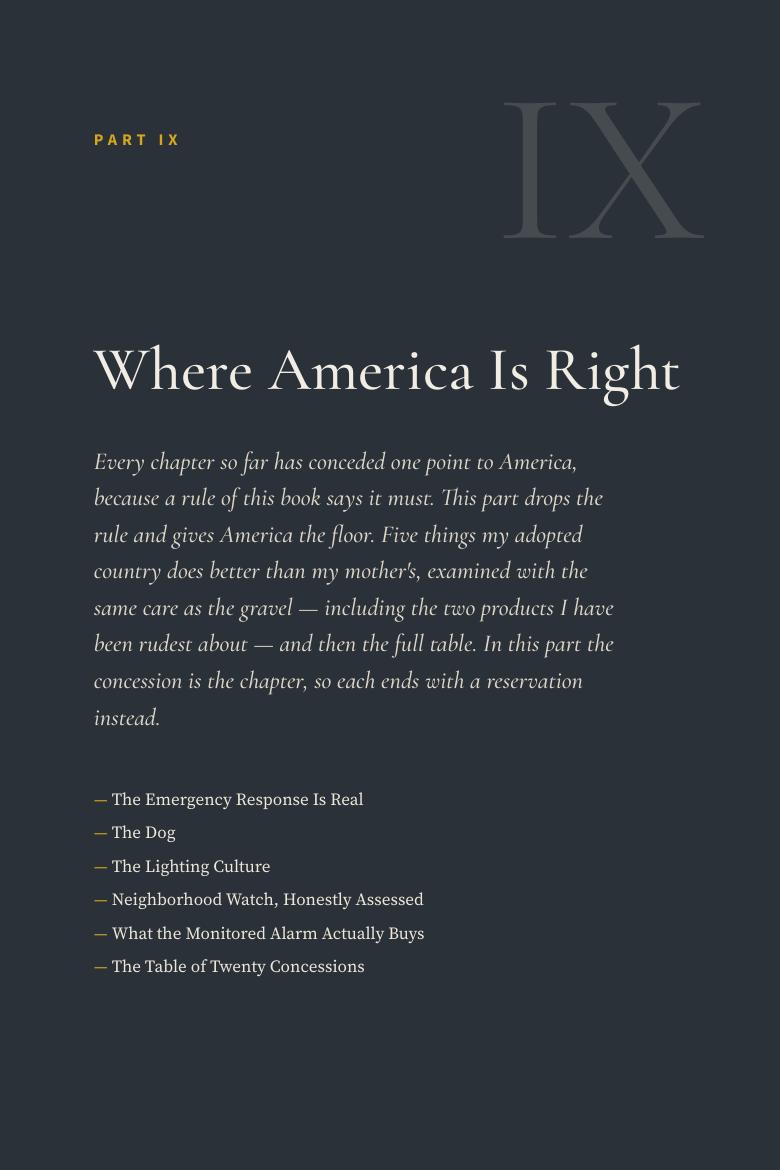
IX · Where America Is RightTwenty concessions, in one table: the emergency response, the dog, the lighting culture, what the monitored alarm actually buys. All meant.
X · The Frauds at the DoorThe frauds at the door — the callers who target the old, the call-back rule, protocol beats suspicion.
XI · The Empty HouseThe empty house — the house that tells no one it's empty; the mail, the laundry, the timer; the neighbor who holds the key.
XII · The Quiet IndustryThe quiet industry — the five-hundred-yen aisle, a standard instead of a brand, the subscription that watches vs the gravel that prevents.
XIII · The SystemYour turn: the Choosing Question, the ninety-second look from across the street, the audit station by station, seven evenings of layers.
XIV · The Two Houses at NightHer house at ten p.m., in full; the safety America sells; and the machinery nobody sells, because it's gravel.

See all 86 chapters

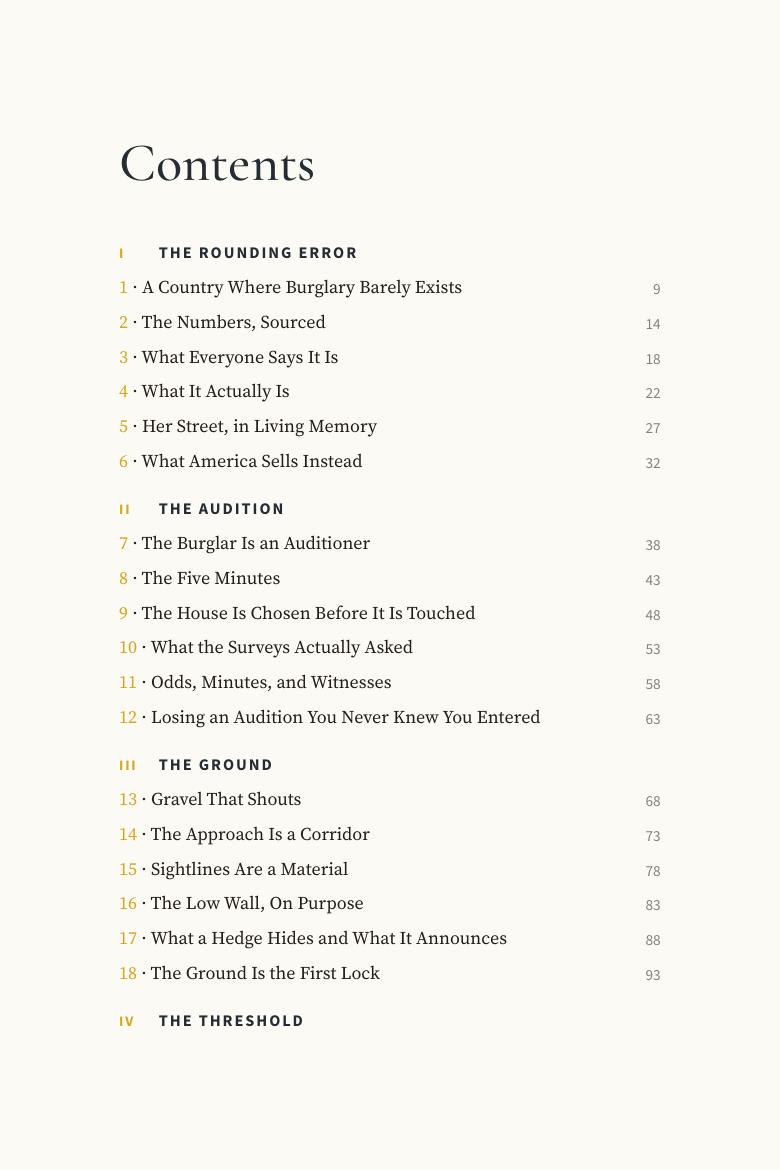
I · The Rounding Error

  1. A Country Where Burglary Barely Exists
  2. The Numbers, Sourced
  3. What Everyone Says It Is
  4. What It Actually Is
  5. Her Street, in Living Memory
  6. What America Sells Instead

II · The Audition

  1. The Burglar Is an Auditioner
  2. The Five Minutes
  3. The House Is Chosen Before It Is Touched
  4. What the Surveys Actually Asked
  5. Odds, Minutes, and Witnesses
  6. Losing an Audition You Never Knew You Entered

III · The Ground

  1. Gravel That Shouts
  2. The Approach Is a Corridor
  3. Sightlines Are a Material
  4. The Low Wall, On Purpose
  5. What a Hedge Hides and What It Announces
  6. The Ground Is the First Lock

IV · The Threshold

  1. The Step Down at the Door
  2. One Door, Two Locks
  3. The Supplementary Lock the Police Recommend
  4. The CP Mark — a Standard, Not a Brand
  5. Five Minutes, Engineered
  6. The Door Is a Schedule, Not a Wall

V · The Windows

  1. Where the Audition Is Usually Won
  2. The Second Lock on the Sash
  3. Film, Bars, and the Honest Limits of Each
  4. The Amado — Shutters as Bedtime Ritual
  5. The Bathroom Window Everyone Forgets
  6. Glass Is a Time Question

VI · The Light and the Dark

  1. The Lived-In Look Is a Craft
  2. The Timer Is Older Than the App
  3. The Sensor Light's One Job
  4. Curtains, Laundry, and the Calendar You Broadcast
  5. Dark Where You Watch, Light Where They Choose
  6. The Night Shift of an Ordinary House

VII · The Intercom

  1. Standard Equipment Since the Eighties
  2. The Door Is Answered Without Opening
  3. The Unverified Visitor Protocol
  4. The Chain Is Not the Answer — the Habit Is
  5. What the Camera Doorbell Got Right, and What It Subscribed
  6. Speaking Through the Wall as a System

VIII · The Street that Answers

  1. The Police Box Three Minutes Away
  2. The Officer Who Visits — Junkai Renraku
  3. The Good-Morning as Surveillance
  4. The Circular Board Knows the Street
  5. Eyes Without Cameras
  6. What a Street Can Refuse Together

IX · Where America Is Right

  1. The Emergency Response Is Real
  2. The Dog
  3. The Lighting Culture
  4. Neighborhood Watch, Honestly Assessed
  5. What the Monitored Alarm Actually Buys
  6. The Table of Twenty Concessions

X · The Frauds at the Door

  1. The Other Way Into a House
  2. The Callers Who Target the Old
  3. The Call-Back Rule
  4. Never Verified, Never Opened
  5. The Machinery Her Police Visit Built
  6. Protocol Beats Suspicion

XI · The Empty House

  1. The House That Tells No One It's Empty
  2. The Mail, the Laundry, the Timer
  3. The Neighbor Who Holds the Key
  4. Nine Million Empty Houses, Revisited at Night
  5. Leaving for Two Weeks, the Checklist
  6. The Second Home's Second Job

XII · The Quiet Industry

  1. The Five-Hundred-Yen Aisle
  2. A Standard Instead of a Brand
  3. The Subscription That Watches vs the Gravel That Prevents
  4. What the Sign Alone Is Worth
  5. Pocket Money, Priced in Both Currencies
  6. Deterrence Has No Monthly Fee

XIII · The System

  1. The Choosing Question
  2. The Ninety-Second Look, From Across the Street
  3. The Audit, Station by Station
  4. Seven Evenings, Seven Layers
  5. The Order to Do Things In
  6. Renters, Apartments, and What Still Applies
  7. The Family Conversation About the Door
  8. What to Copy, What to Leave Japanese

XIV · The Two Houses at Night

  1. Her House at Ten P.M., in Full
  2. The Safety America Sells
  3. The Machinery Nobody Sells, Because It's Gravel
  4. The Street as the Last Lock
  5. The Rounding Error, Explained at Last
  6. The Safe House Is a Verb
  7. Glossary
  8. The Source Ledger
  9. The Myth Register
  10. Seven Evenings, Seven Layers
  11. The House Audit, From the Outside
Ken Tsukamoto

A note from Ken

Everyone here calls me Ken. My mother still calls me Kenichi. She is in her seventies and lives alone at the edge of a field, in the house I grew up in, and she has never once been burgled — nor has anyone on her street, in living memory. For years I accepted the explanation everyone offers: Japanese honesty. Then I looked at what was actually under her windows, on her path, at her door, and up the street, and found machinery at every layer — most of it cheap, none of it subscribed, all of it boring.

I am not the good example. In America I pay monthly for a camera that has recorded nothing, kept a yard sign for an alarm I never owned, and secured a sliding door with optimism for a decade. This book is what I found when I priced the feeling of safety I was buying against the machinery she uses — written from inside the American subscription, not from above it.

One promise about register: no fear in this book. No crime stories, no worst nights. A well-run system is calm, and so is the writing about it.

Ken Tsukamoto · The Safe House on YouTube

If it's not for you, it costs nothing.

Email twohousesbyken@gmail.com within 30 days and I'll refund you. No form, no questions.

How it works

Tap "Get the Book"

A checkout window opens right here on this page.

Pay securely

Card, PayPal or Apple Pay. Checkout is handled by Gumroad, which has processed payments for creators since 2011.

The book arrives by email

Within a minute. Open it on your iPad, phone or computer — or print it. It's yours to keep.

Questions people ask

Is this a printed book?

No. It is a digital book — a PDF file, 482 pages, set at 6 by 9 inches. It reads like a printed book on a tablet, and you can print any or all of it yourself. There is no shipping and nothing arrives in the post.

Is this a security manual?

No — it is a deterrence book, and it is strict about the difference. It ends at the property line: no weapons, no confrontation tactics, nothing about defeating locks or systems, and nothing about what to do if someone is inside except the one sentence that belongs there — leave if you can, and call the emergency number where you live. And nothing in it is a guarantee: its currencies are odds, minutes, and witnesses. What it teaches is how houses get chosen, and how yours quietly declines the audition.

Do I need Ken's other books first?

No. The books are siblings, not a series — this one stands entirely on its own. If you've read the others, you'll recognise the house, the mother, and the gravel you can hear from the kitchen.

How do I open a PDF?

You already can. Every iPad, iPhone, Android phone, Mac and Windows computer opens PDFs without installing anything. Tap the link in the email and it opens. On an iPad, tap the share icon and choose "Save to Books" to keep it on your shelf.

Can I print it?

Yes. It is set at 6 by 9 inches, which fits letter and A4 paper two pages side by side, or one page per sheet. Seven Evenings, Seven Layers and the House Audit at the back are designed to be printed.

Can I read it on a Kindle?

Yes, with a caveat. You can send the PDF to your Kindle by email and it will open, but the pages will be small on an older Kindle. It is far better on an iPad, a Kindle Fire, a laptop, or on paper.

Is my card information safe?

Yes. I never see your card. Payment is handled by Gumroad, a checkout company used by hundreds of thousands of writers and creators. Your card details go to them, encrypted, and never to me. PayPal and Apple Pay work too, if you'd rather not type a card number at all.

Why $47?

It is 482 pages and every number in it sits in a source ledger I stand behind. A hardback of this size would be $40 to $50 in a shop, and I would have to sell it through a shop. This way you pay less than that, it arrives in a minute, and the price includes a full refund if you decide it isn't for you.

Will the price really go up?

Yes. $47 is the early-bird price for the first readers. When the launch window closes it moves to $79. If you can see the $47 price on this page, it hasn't yet.

What if I can't download it?

Email twohousesbyken@gmail.com and I will send the file directly to you. Gumroad also keeps a copy in your account, so you can download it again any time, on any device.

Not ready? Read one chapter free.

Chapter 1 — A Country Where Burglary Barely Exists. The rounding error, sourced; the honesty story, retired; the machinery, promised. Enter your email and it opens right here — I'll send a copy to your inbox too.

One email with the chapter. If you buy the book later, I stop mentioning it.

Stand across the street tonight. Ninety seconds.

Look at your house the way the person who chooses houses does. If you don't know what they saw — that is the whole reason this book exists. The house is chosen before it is touched, and every layer that un-chooses it is in here, priced in pocket money.

$47$79

Early-bird price until the launch window closes.

Get the Book — $47

Digital book (PDF) · 30-day money-back guarantee · Secure checkout